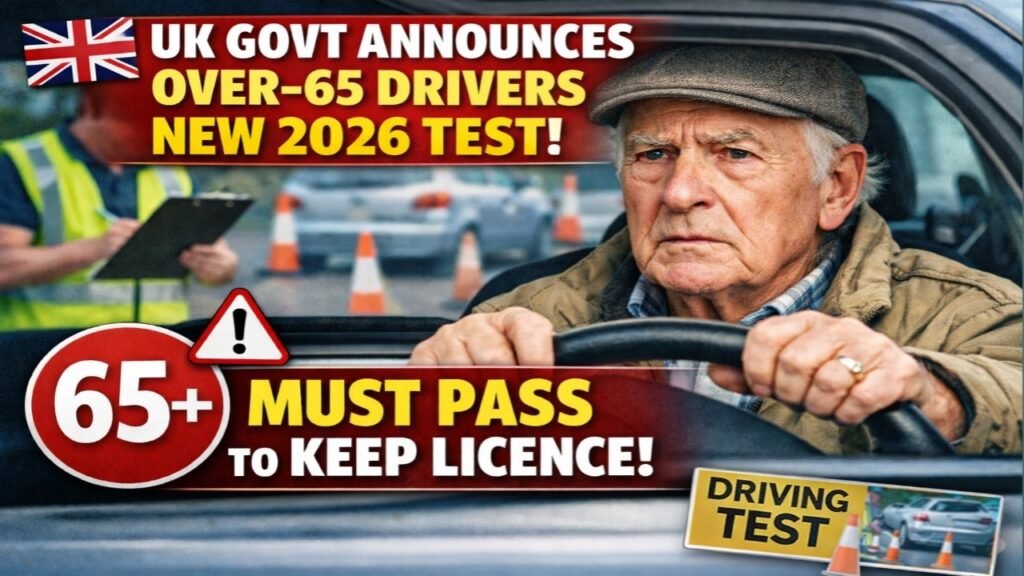
Hello Everyone, There has been a lot of talk lately across the UK regarding changes to how older motorists keep their driving licences. If you have seen headlines suggesting that the government is introducing a brand-new driving test for everyone over 65 in 2026, you might be feeling a bit anxious. For many, a car is not just a vehicle; it is a lifeline to the community, family, and independence.
The reality of the situation is slightly more nuanced than the “pass or fail” headlines suggest. While there isn’t a new “practical driving test” like the one you took as a teenager, the government is moving toward stricter checks. These updates are designed to ensure that as the UK population ages, our roads remain safe for everyone.
What is Actually Changing in 2026?
The biggest shift coming into focus for 2026 involves how the DVLA (Driver and Vehicle Licensing Agency) handles licence renewals for those reaching the age of 70 and beyond. Up until now, renewing your licence has largely been a matter of “self-declaration.” You would receive a form, tick a box to say you are fit, and that was that.
However, from 2026, the government is pushing for a more robust verification process. The focus is shifting from “tell us you’re fine” to “show us you’re fine.” This means that while you won’t necessarily be asked to perform a three-point turn for an examiner, you will likely face mandatory professional health checks, specifically regarding your vision.

The Mandatory Eyesight Consultation
One of the most significant updates for 2026 is the proposal for mandatory eyesight tests. Currently, the DVLA expects you to be able to read a number plate from 20 metres. In the past, they took your word for it during the renewal process. New proposals suggest that drivers over 70 may soon need to provide proof from an optician.
This “test” is simply a professional eye exam to ensure your vision meets the legal standard for driving. If you already wear glasses and have regular check-ups, this shouldn’t be a hurdle. The goal is to catch vision deterioration—such as cataracts or glaucoma—that a driver might not even notice is happening gradually over time.
Why 2026 is a Milestone Year
You might wonder why 2026 is being cited as the year of change. This date aligns with the UK’s new Road Safety Strategy. The government is looking at European neighbours who already have mandatory medicals for senior drivers and is aiming to bring the UK’s “honour system” up to a more modern, data-driven standard.
- Professional Verification: Moving away from self-reporting to certified medical results.
- Digital Integration: Using optician results that can be sent directly to the DVLA database.
- Increased Frequency: Keeping the three-year renewal cycle but with added medical requirements.
- Safety Focus: Reducing the number of road incidents linked to preventable age-related health issues.
The Renewal Process for Over 70s
It is important to remember that in the UK, your driving licence automatically expires on your 70th birthday. This does not mean you have to stop driving, but it does mean you must apply for a new one. Under the 2026 guidelines, this process is becoming more digital and more detailed than in previous decades.
The DVLA will still send you a reminder about 90 days before your 70th birthday. If you want to keep your licence, you will need to fill out the renewal form (D46P). The difference now is the level of detail required regarding your medical history and the potential requirement for that professional eye test certificate to be attached.
Medical Conditions You Must Declare
Aside from eyesight, the DVLA is becoming stricter about “notifiable conditions.” These are health issues that could impact your ability to react quickly or stay focused on the road. While many of these have always been on the list, the enforcement is expected to tighten as we move through 2026.
- Dementia and Memory Loss: Any cognitive decline must be reported immediately.
- Diabetes: Specifically if it is treated with insulin or carries a risk of hypoglycaemia.
- Neurological Issues: This includes epilepsy, Parkinson’s, or recent strokes.
- Heart Conditions: Any condition that could cause sudden dizziness or loss of consciousness.
- Sleep Apnoea: Or any condition that causes excessive daytime sleepiness.
Will There Be a Practical Retest?
To set the record straight: there is currently no plan to make every 65 or 70-year-old retake their practical driving test. A retest is usually only triggered if a doctor expresses concerns about your ability, or if you are involved in a serious accident where your fitness to drive is called into question by the police.
What is being discussed is an “Experienced Driver Assessment.” These are voluntary 60-minute sessions where an observer gives you feedback on your driving. While not a “pass/fail” exam, the government is encouraging more older drivers to take these to stay sharp and confident on today’s much busier and faster roads.
How to Prepare for the New Rules
If you are approaching 65 or 70, the best way to prepare for the 2026 changes is to stay proactive about your health. Don’t wait for the DVLA to ask for a vision report; ensure you are seeing your optician every two years as recommended by the NHS. Being able to provide a clean bill of health makes the renewal process seamless.
It is also worth familiarising yourself with the online renewal system on the GOV.UK website. It is much faster than the postal route, and for those over 70, the renewal is free of charge. Keeping your digital skills up to date will help you manage your licence without needing to rely on third-party services that often charge unnecessary fees.
Final Thoughts
The news of a “2026 test” for older drivers can sound intimidating, but it is really about evolving road safety. The UK government isn’t trying to take away your keys; they are trying to ensure that every mile you drive is as safe as possible for you and others. By shifting from self-declaration to professional checks, the system becomes fairer and more reliable. Stay healthy, keep your eye appointments, and you should have no trouble staying behind the wheel for years to come.
Disclaimer: This article is for informational purposes only and does not constitute legal or medical advice. Driving regulations can change; always check the official GOV.UK website or contact the DVLA for the most current rules and requirements regarding driving licences and medical fitness in the United Kingdom.